
We are a few months into the first Group 1 ASRS climate report lodgements and one thing comes up in almost every engagement: organisations have spent a lot of energy on the framework and not enough on the data behind it.
What the standard expects
The Strategy pillar requires you to disclose the current financial effects of climate-related risks on your business… meaning what it has cost you, or what you expect it to cost you. The expectation is that you put a number to it where you can.
There is a qualitative fallback, but it comes with conditions. You can only use it if preparing a number would require disproportionate cost or effort, or if the risk does not apply. If you go that route, you still have to describe the effect in words, explain why you could not quantify it, and name what you are doing to fix that gap for next year.
In other words, qualitative disclosure is a defined fallback, not a way to avoid the question.
AASB S2 • From Climate Risk To Financial Disclosure
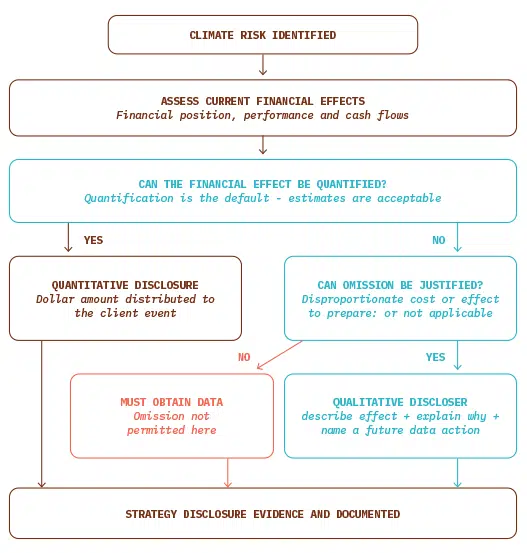
Figure 1: From climate risk to financial disclosure: the decision path
The real problem
Most businesses do not lack data. They have plenty of it. What they lack is data that was captured with climate attribution in mind.
Take maintenance.
- A work order system records job type, cost and hours. It does not record what caused the job. So, when you get a spike in reactive maintenance during a heat event, the cost is sitting in the system, but buried alongside routine scheduled work, with nothing to distinguish them except dates and a technician’s description. Getting a defensible number out of that takes a methodology, not just a filter.
Take hotels.
- A property management system captures occupancy and revenue by date. It does not capture why a booking was cancelled. A storm or a flood can suppress demand for days. But without a cancellation reason code in the system, there is no direct line from the weather event to the revenue impact.
Take insurance.
- Premiums go up every year. But the renewal invoice does not break down how much of that increase is climate-driven versus general market movement. For a portfolio with significant exposure in cyclone or flood zones, that disaggregation matters.
This is the standard situation for most large Australian property businesses walking into their first lodgement.
What good looks like
The businesses that get this right start the data work early and approach it in two steps.
First, take stock of what you already have.
- Most operational systems are more useful than they look, if you can build a methodology around them. A work order log with dates is useful if you can cross-reference it against Bureau of Meteorology records and isolate the spike.
- A hotel booking report is useful if you have the event dates and a prior-year baseline to compare against. The system does not need to have been built for climate disclosure. It needs to be capable of supporting a traceable, documented chain from data point to claim.
AASB S2 • How Operational Data Becomes Disclosure Evidence
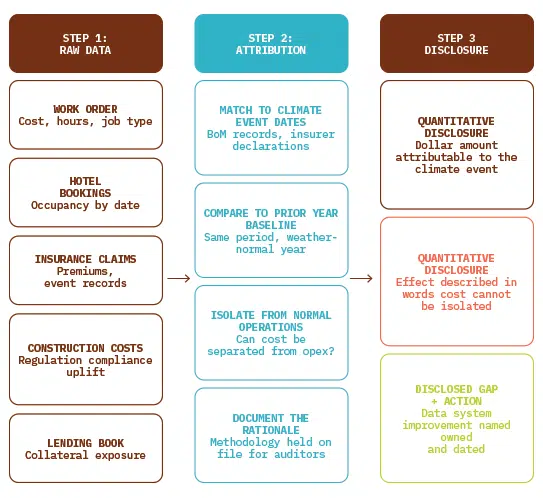
Key Principle: Every data point needs a traceable path from a named system, through a documented method, to a specific disclosure outcome.
Figure 2: How operational data becomes disclosure evidence
Second, document the gaps properly rather than leaving them blank. If you cannot put a number to something, say so clearly, describe the effect in words, explain why the number was not available, and name the specific action you are taking to capture it properly next year. That is an auditor-ready position. A gap with no explanation is not.
AASB S2 • When Can You Use Qualitative Disclosure?
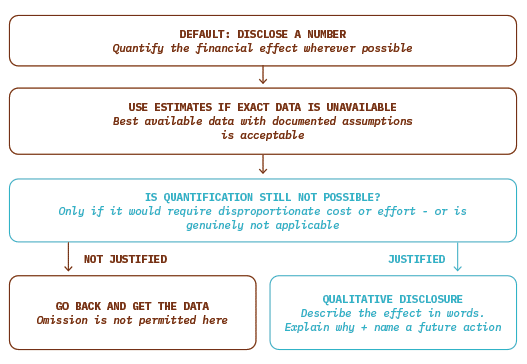
Figure 3: When qualitative disclosure is permitted — and what it must include
What auditors are looking at
Limited assurance is a review of whether the methodology is reasonable, the assumptions are documented, and the entity has been honest about what it knows and does not know.
An organisation that has clean numbers for some risks, a well-explained qualitative position for others, and a named improvement action for each gap is in a solid position. One that has big claims with no trail behind them, or gaps that are simply absent from the disclosure, is not.
Start early. Be specific about what you need and who holds it. And document every step… not just the answer, but how you got there.