The best climate risk data most organisations have sits with the people who actually run the business.
The site manager who shut down a western Sydney construction site six times last summer because it was too hot to work.
The facilities manager who watched a basement carpark fill with water in 2022 and then spent six months chasing an insurance claim.
The procurement lead who noticed steel prices creeping up and heard the word “carbon” in a supplier conversation for the first time.
That knowledge connects directly to financial impact. Yet for most organisations conducting a climate risk assessment in Australia for the first time, it’s sitting completely untapped.
Key Takeaways
- Auditor Risk: Most first AASB S2 disclosures look complete on paper but lack operational substance, and an auditor will find the gaps.
- The Data You Already Have: The most valuable climate risk data exists within your business, with the frontline staff who run it.
- Mandatory Opportunities: AASB S2 requires climate opportunities to be disclosed alongside risks, which compliance-only approaches consistently miss.
Here’s where most organisations start
Most organisations approaching mandatory climate disclosure for the first time produce something that looks complete. They include the right categories, use the right language, and cover the four pillars.
However, these reports often lack operational substance. An auditor will find the gaps quickly. More importantly, the business still will not actually know what its true climate risks are.
AASB S2 requires you to demonstrate that your risk identification process involves appropriate stakeholders, uses reasonable and supportable information, and is thoroughly documented. Getting this right starts well before you open a spreadsheet.
So, we start with one question
Before anyone in our workshops thinks about future risks, scenario analysis, or financial impact pathways, we ask one question.
“When has weather or climate already caught your organisation off guard?”
We ask participants to focus on everyday operational moments:
- A concrete pour aborted because of sudden humidity.
- Workers leaving a project site early on a hot afternoon more times than you could justify.
- An insurer at renewal asking for specific asset flood risk data that nobody held.
- A buyer at a display suite asking about solar options and nobody knowing how to answer.
We give participants a physical timeline and ask them to populate it with real, dated events connected to an actual cost or disruption. This simple exercise achieves two things:
- It grounds the room in operational reality before anyone starts speculating about the future.
- It produces direct evidence, documented by the people who lived it, that the organisation’s climate risks are real.
Why seniority matters less than experience
The person who should be in the room is the person with the most direct experience of climate affecting their daily work.
- The Site Manager: A manager who has built weather day contingency into project budgets for three years understands the financial materiality of extreme heat better than any external dataset.
- The Facilities Manager: A manager who has dealt with strata insurance renewals increasing 30% to 40% consecutively understands insurance stress better than a generic risk framework.
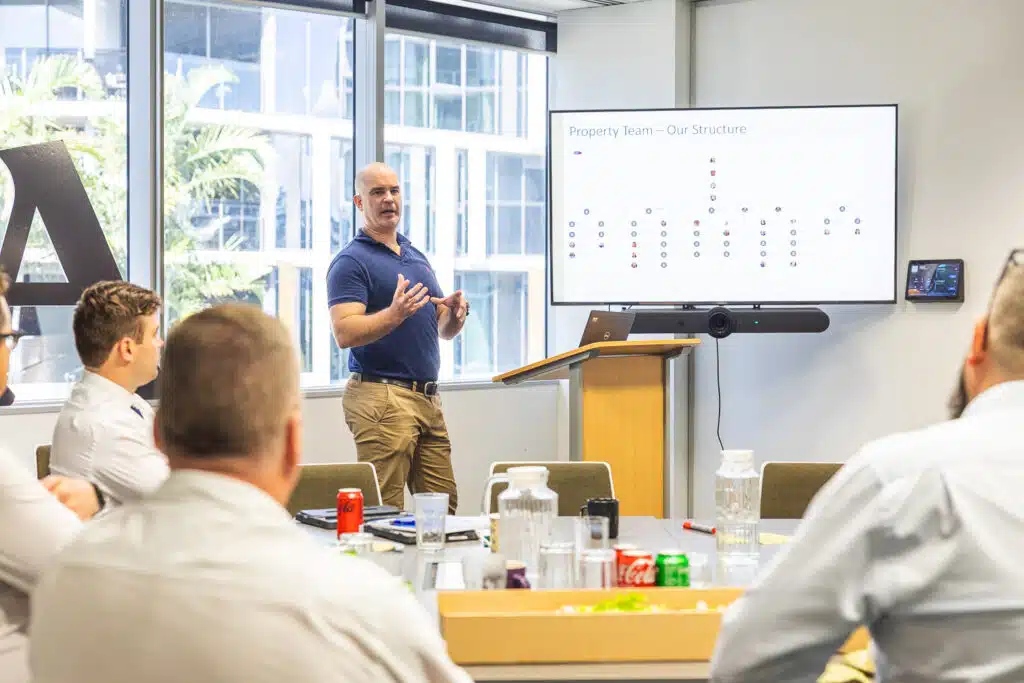
After completing the past climate impacts activity, we split our workshops into two distinct groups:
- Operational Teams: Site managers, facilities managers, maintenance leads, and construction staff work exclusively on physical climate risks.
- Corporate Team: Finance, procurement, risk, and strategy specialists work exclusively on climate change transition risks.
The discipline that makes it auditable
Before anyone places a sticky note on our workshop boards, they must ask themselves three questions:
- Has this already happened to us, even once?
- Can I name a specific site, building, or relationship this affects?
- If this happened tomorrow, whose phone would ring?
If a participant cannot answer at least two of those questions, they must revise the note before posting it. This discipline separates a climate risk register that holds up under scrutiny from one that simply looks good on paper.
- Expert Tip: Every risk in your register must be traceable to either a direct operational experience or a published evidence source. If it isn’t, it shouldn’t be in the register.
For more on how climate risk fits into your broader governance framework, read: The Boardroom Blind Spot →
Then, the groups challenge each other
After the breakout session, the groups swap boards. They receive one specific tool, which is an orange sticky note.
Participants use the orange note if a risk does not feel real for the organisation, if a description is too vague, or if an important issue is missing. This process requires complete silence, and every challenge must go on a note.
This exercise stops the loudest person in the room from dominating the conversation. It forces every challenge to be articulated in writing. It also surfaces risks that one group thought were entirely obvious but the other group had never considered.
One vital thing most organisations forget
AASB S2 requires climate opportunities to be disclosed alongside risks as a mandatory rule, not an optional addition. These essential strategic items belong directly in your register:
- Green finance access.
- Market differentiation through climate-resilient property design
- On-site commercial solar installations
- The pricing premium available to apartments with strong NatHERS ratings
We spend the final part of every workshop focused entirely on these areas. The organisations that get this right come out of the process with a clearer view of where climate creates commercial upside, not just where it creates risk.
The final asset: Your boardroom-ready risk register
The output is a raw, sourced longlist of physical and transition climate risks. These are identified by the people who run the business, challenged by their peers, and documented with source tags that trace back to operational experience or published evidence.
Every risk survives a peer challenge and links directly to a financial impact pathway. This data feeds into your Enterprise Risk Framework, then into scenario analysis across the two required AASB S2 pathways, and finally into the disclosure itself.
This is not the fastest way to produce a climate risk register. But it is the only way to produce one that is genuinely owned by the business, and it will hold up when scrutiny arrives, which it will.
- Understand your ASRS climate risk obligations before your next board meeting. Read our plain-English guide to ASRS climate reporting →
- Not sure where your organisation’s climate risk gaps are? Take the free Climate Readiness Assessment →
Frequently Asked Questions
AASB S2 is Australia’s mandatory climate disclosure standard. It requires organisations to identify and report their physical and transition climate risks across four core pillars: governance, strategy, risk management, plus metrics and targets.
AASB S2 requires appropriate stakeholders to be involved in risk identification. In practice, this means involving operational staff like site managers, facilities managers, and procurement leads alongside finance and risk teams.
Physical risks relate to direct climate events like extreme heat, flooding, and storms affecting assets. Transition risks relate to the economic shift toward net zero, including carbon pricing, changing regulations, and shifting market preferences.
Yes. AASB S2 explicitly requires climate opportunities, such as green finance access, resilient design premiums, and on-site renewable energy, to be disclosed alongside risks.
The workshop produces a sourced longlist of risks verified by frontline staff. This data feeds directly into your enterprise risk framework, moves through mandatory scenario analysis pathways, and forms the basis of your legal disclosure.